
By Steve Sucato
DANCECleveland simultaneously capped its annual Community Dance Day activities and opened its 68th presenting season Saturday night at Playhouse Square’s Allen Theatre with the return of Oberlin Dance Collective (ODC/Dance).
Founded in 1971 at Oberlin College by artistic director Brenda Way, who was then on faculty, the San Francisco-based dance company last returned to Northeast Ohio in 2015.
The company presented a triple bill of repertory works, two by Way and the other by ODC/Dance associate choreographer Kimi Okada.
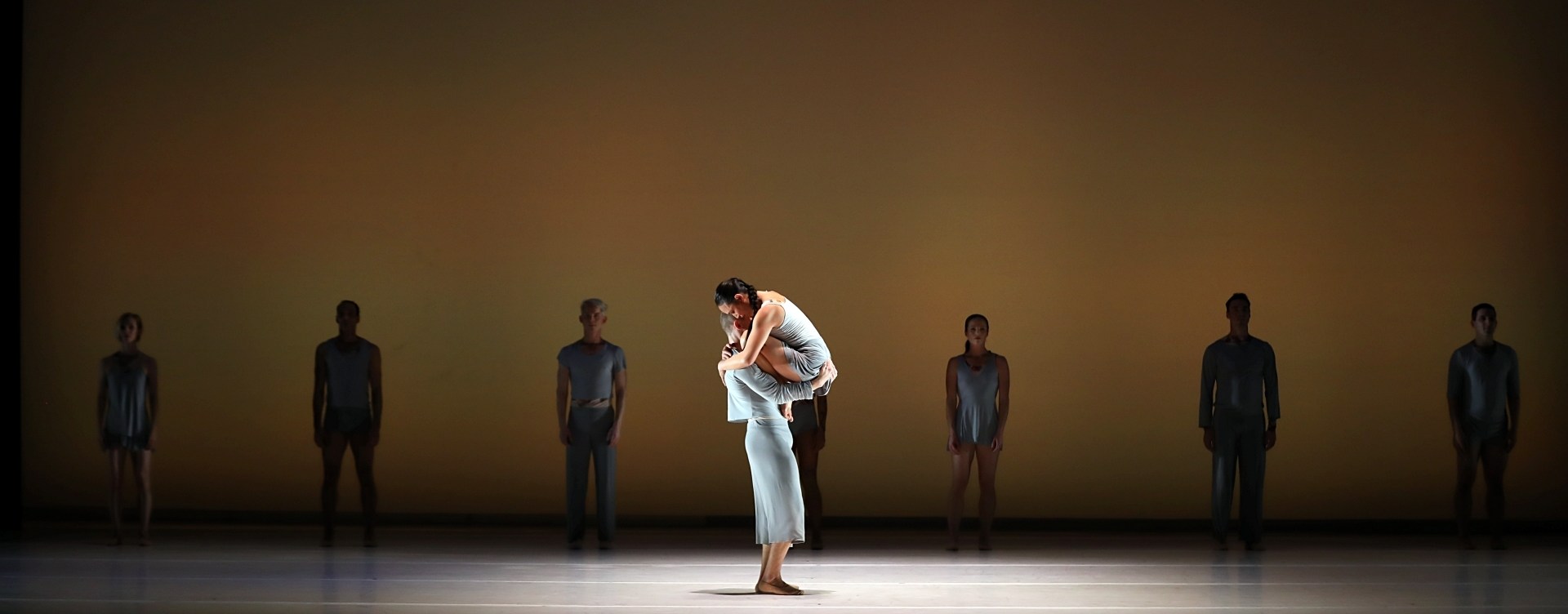
The program opened with Way’s recently premiered “A Brief History of Up and Down” (2024). The work for ten dancers set to music by Baroque composer Johann Heinrich Schmelzer was, according to Way in an interview about the work, to focus on the evolution of the company’s dance works over its 55-year history and use projected text showing prompt questions about the creative process. Due to technical difficulties, that text never appeared. Instead, what the audience got was perhaps an equally intriguing dance work that harkened back to its 1970s roots with modern dance’s focus on pedestrian movement as dancers walked about the stage to the sound of old-fashioned typewriter typing. In places where text was to be shown, we saw a placeholder graphic that appeared and disappeared, harkening back to the experimental use of film and video images in 20th-century dance works.
Way’s choreography for the piece was dense with movement gestures and had a captivating ease and flow to it and highlighted what she says is the company’s occupation of a stylistic space between ballet and modern dance. In that space, Way and the company’s group of largely seasoned dancers have found visual magic that is at once familiar and fresh.
A standout throughout the program, Rachel Furst first caught our attention in a section of the work meticulously flexing and wriggling her toes. She and fellow dancers then found themselves lifted upside down, peddling their legs in the air and later cascading into and onto one another in silky-smooth interconnected dance movements and phrases.
Other memorable sections featured Miche Wong being lifted and carried by two male dancers to seemingly dance on air, her feet never touching the ground and the work’s complement of dancers making playful runs across the stage a la Paul Taylor’s “Esplanade” without sliding to the stage floor.
Undoubtedly less guided in its intent, it is hard to know exactly how different A Brief History of Up and Down would have been perceived if its text graphics had appeared as intended. The audience’s focus being shifted squarely on the dancers, however, paid off in pleasing ways.
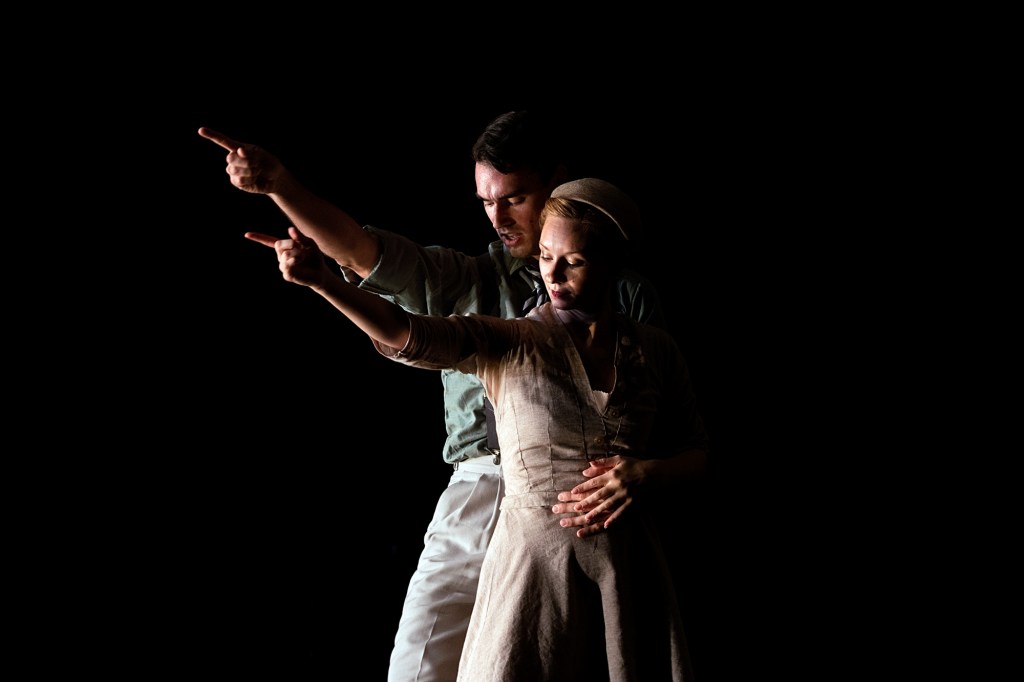
Next, Okada’s “Two if by Sea” (2014) showed an even quirkier side to ODC/Dance. A duet performed by Furst and Ryan Rouland Smith in World War II-era-ish civilian costume. Performed to a commissioned score by Teiji Ito and Steve Reich, Okada adopted a metaphor for the piece of two ships at sea signaling one another to illustrate a courtship between characters portrayed by Furst and Smith.
The work began with the opening and closing of metal shutters on a stage lamp simulating ship signaling. Furst and Smith, seated in chairs and wearing tap shoes, then tapped out what sounded like Morse code messages directed toward one another.
The endearing premise was further played out as the pair traded their tap shoes for ballet flats and began a flirtatious dance of off-angled idiosyncratic movements, including duck walks and semaphore-looking arm waving to a soundtrack of clicks and “sssss-ing” noises.
Both Furst and Smith were brilliant in the clever duet, which seemed to revel in its zaniness and charm. The duet ended with the two racing about the stage to vibraphone music and collapsing to the stage in exhaustion.
The program closed with Way’s 2023 group work, “Collision, Collapse, and a Coda,” performed to an eclectic mix of music from Aphex Twin (ambient) to Chopin.
Way’s response to what she calls “the daily barrage of violent, aggressive, and disparaging news stories, and the solace we find in the care of intimacy,” the 25-minute work began with a rapid-fire solo by dancer Colton Wall. Then, as the rest of the company filtered onto the stage, similarities to “A Brief History of Up and Down’s” gestural movement emerged, with the dancers streaming into her preferred vocabulary of dance moves, formations, and tableaus. Matching the music’s vibrant intensity and pace, Way’s athletic choreography for the dancers here was punchier and more refined for a 21st-century palette.
The choreography, which contained a myriad of visual stimulation infused with imagery of collision and collapsing, was divided into group sections, pas de deux, and various other dancer formations. Of note was a pas de deux featuring a shirtless Wall and dancer Addison Norman in which the pair spun, pulled, and leaned into and onto one another.
Perhaps the work’s finest moments came in its coda, which saw a shift of mood, trading urgency for grace and the soft interconnectedness of entwining bodies. Heartfelt and musical, the section was beyond lovely and brought to a close a gratifying evening of dance that the audience rewarded with a standing ovation.

 artsair.art