

Malpaso Dance Company
Chautauqua Institution
Chautauqua, NY
July 9, 2025
By Steve Sucato
Arguably Cuba’s best-known contemporary dance export in the United States, Malpaso Dance Company, returned to the Chautauqua Institution for its first mainstage Amphitheater performance on July 9, which featured a triple bill of repertory works.
The 9-member troupe opened its performance to a partially filled Amphitheater audience with New York City-based b-girl Ephrat Asherie’s “Floor… y Ando” (2023). The work, performed by dancers Esteban Aguilar, Esven González, and Malpaso Artistic Director Osnel Delgado, was a blend of hip-hop and breakdance choreography designed for the stage.
A stylistic outlier to the bulk of Malpaso’s repertoire, “Floor… y Ando” was danced to a classical music score by Cuban pianist and composer Aldo López-Gavilán, which was in stark juxtaposition to Asherie’s structured street dance choreography.

George Koloski/The Chautauquan Daily.
Begun with the dancers positioned center stage in a large pool of light, the trio moved at a leisurely pace about the stage, surging in and out of movement phrases, which, while engaging, revealed the dancers’ underwhelming breaking skills. Their finest efforts came in unison group dance sections, which were solidly interesting and nicely danced.
While “Floor… y Ando” came up a bit lacking in fit for Malpaso, company Co-Founder and Associate Artistic Director Daile Carrazana’s 2022 contemporary dance work “La Última Canción” (The Last Song) was tailor-made for it.
In silence, Laura Rodriguez, a lone figure in a red jumpsuit, traversed the bare stage, executing structured dance poses and balances, twisting and contorting her body in what appeared to be an exercise in control.
As the work’s music soundtrack from María Teresa Vera, Lorenzo Hierrezuelo, and Jordi Sabatés began, Rodriguez was replaced onstage by Jennifer Suárez Ramos, costumed in yellow, and Aguilar, whom Ramos began climbing onto. The pair then launched into quirky snippets of gestural choreography, where they reached behind and between their legs, wiggling one hand frantically, and then flung their bodies into the air as if in the throes of violent, full-body twitch.
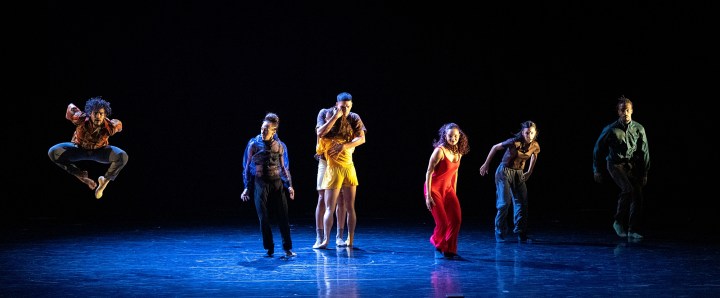
In a playbill note about “La Última Canción,” Carrazana said, “The work is part of a series in tribute to the iconic Cuban singer Bola de Nieve. It is an inquiry into the feeling of loss, an exploration of the uncertainty of existence.”
The bizarrely beautiful work conveyed a bit of all that, but with a playfulness that belied its serious subject matter.
Rodriguez returned to the stage, along with three other company members, to join Ramos and Aguilar in a unison movement phrase filled with hand-clapping, finger-snapping, jumps, and spins, performed to piano music with a jazz noir detective feel.
While the dancers appeared to share some connections, you got the sense that they could have also been strangers to one another. The emotions they expressed were fleeting. From one moment to the next, each dancer appeared to discard whatever they were feeling onto the stage floor to be forgotten or be scooped up and embraced by another dancer.
In the end, “La Última Canción” proved to be a perfect marriage of Cuban sensibilities and unique contemporary dance choreography.

The program closed with the dean of smooth dance choreography, Ronald K Brown’s “Why You Follow” (2014).
A work for the full company of nine dancers, it was inspired by the West African ethnic group Yoruba’s deity Elegua, the guardian of the crossroads, the opener of paths, and the messenger between the human and divine realms.
Employing Brown’s signature blend of African and American modern dance styles, the multi-section piece began with Malpaso’s dancers in street clothes and barefoot, entering from one side of the stage, alone or in pairs, and dancing across to exit the other. Performing to the song “Look at Africa” by Zap Mama, Brown’s choreography for this opening section was predominantly Afro-Cuban dance movement that flowed from the dancers in moderately-paced rhythmic step dance phrases.
Switching gears, the work’s second section danced to “Yoruba Road” by The Allenko Brotherhood, brought the funk both musically and choreographically. The dancers, as a group, traversed the bare stage with a cooler-than-you attitude in large, bouncy, and bounding chunks of shoulder-shifting, finger-pointing, and arm-waving modern dance movement that took the viewer on a ride with them.
Using all of Brown’s signature choreographic go-tos, the piece continued to alternate between the dance styles of the first two sections. The subtle nod to the theme of “opening paths” contained in the dancing, along with Malpaso’s dancers’ terrific performances, delighted the Amphitheater audience, which erupted into a rousing standing ovation at work’s end.
It was a fitting conclusion to an entertaining summer evening of dance by the talented troupe that continues to make its mark here in the U.S. and around the globe.

 artsair.art