

By Steve Sucato
For their latest dance work, Ni más/ni menos, this Thursday and Friday at the Cultural Arts Center at Disciples Christian Church in Cleveland Heights, Northeast, Ohio’s flamenco queen, Alice Lawhorn, and her company Abrepaso, ask the question: What happens when invisible fault lines shift beneath our feet?
The world premiere interdisciplinary work explores the struggle for balance in an increasingly fractured world. It features original music by internationally acclaimed composer and multi-instrumentalist Adam Ben Ezra and is a stripped-down, emotionally raw, one-of-a-kind work that showcases an innovative collaboration between Felise Bagley, a celebrated contemporary dancer and founding member of GroundWorks DanceTheater, and Lawhorn, along with a new piece by Sevilla-based Cristina Hall, Abrepaso’s first outside commission.
Together, Ni más/ni menos, blurs the lines between dance forms, and brings the tension and tenderness of real human dialogue to life through movement and music.
For Lawhorn (formerly Alice Blumenfeld), Abrepaso’s founder and executive artistic director, the work is a clear representation of the company’s artistic vision that she outlined in a conversation I had with her about Abrepaso and her career (see below), leading up to Thursday and Friday’s performances.
Born in the Detroit area, Lawhorn’s family moved to Albuquerque, New Mexico, when she was three years old. She had a Bachelor of Arts degree in Comparative Literature from New York University and a Master of Fine Arts degree in dance from Hollins University. She has danced professionally with New York-based Flamenco Vivo and has also guested with several other companies. Her recognitions include a Fulbright Grant to study dance in Seville, Spain, in 2012, being named a 2008 U.S. Presidential Scholar in the Arts, and being a two-time recipient of the Ohio Arts Council Individual Excellence Award in Choreography (2020 and 2022).

As a child, you studied and aspired to be a ballet dancer. What got you interested in ballet?
I always loved to dance and move. My favorite books when I was little were the Angelina Ballerina series, and then when I saw The Nutcracker, that is what made me really want to be a ballerina.
At age 13, all that changed when you attended Festival Flamenco Internacional de Albuquerque. What about Flamenco really spoke to you?
It was watching Marisol Encinias dance that I had what we call in Flamenco, an experience of duende. It was like an out-of-body experience, and I knew right then this was what I wanted to do in life.
In 2012, you received a Fulbright Grant to study Flamenco in Seville, Spain. How did that experience inform your dancing?
I was still in college at NYU, and I asked my mentor in New York, Nélida Tirado, who I should study with in Spain. She told me it didn’t matter; what was important was to live in the culture of Andalusia. Getting to know the culture and the pace there informed my understanding of what Flamenco really is.
You also studied flamenco music there and took singing lessons. Why?
The key to being a good Flamenco dancer is understanding the music. I took a lot of singing classes, but I never really figured out the code to the singing while in Spain. It was actually in Ohio where I met flamenco guitarist/singer Marija Temo, who saw me dance and told me I was missing something in the singing. I took ear training lessons from her, and that took my dancing to the next level.
You danced professionally for several Flamenco troupes in NYC and toured. Why did you decide not to continue that?
I worked extensively with Flamenco Vivo in their New York-based company in 2009, and then toured nationally with them from 2013 to 2015. I learned a great deal from my time with them about teaching, theater etiquette, and lighting, but I felt I wasn’t growing within the company anymore. I wanted to pursue choreography and create and perform pieces that were more non-traditional.


Was that desire for growth as an artist why you founded Abrepaso?
Yes. When I left Flamenco Vivo, I went back to Spain for a while, and when I returned to the United States, I went home to New Mexico and founded the company in 2016.
How did you end up in Cleveland?
Around the time I founded Abrepaso, I was finishing my MFA degree in Dance from Hollins University. I applied for higher education jobs and got one as a visiting professor at Oberlin College. I loved the Midwest from touring with Flamenco Vivo, and when I found out that Cleveland didn’t have a strong flamenco scene, I felt this would be a great place to grow Abrepaso and fill that void.
What is your philosophy when it comes to performing flamenco?
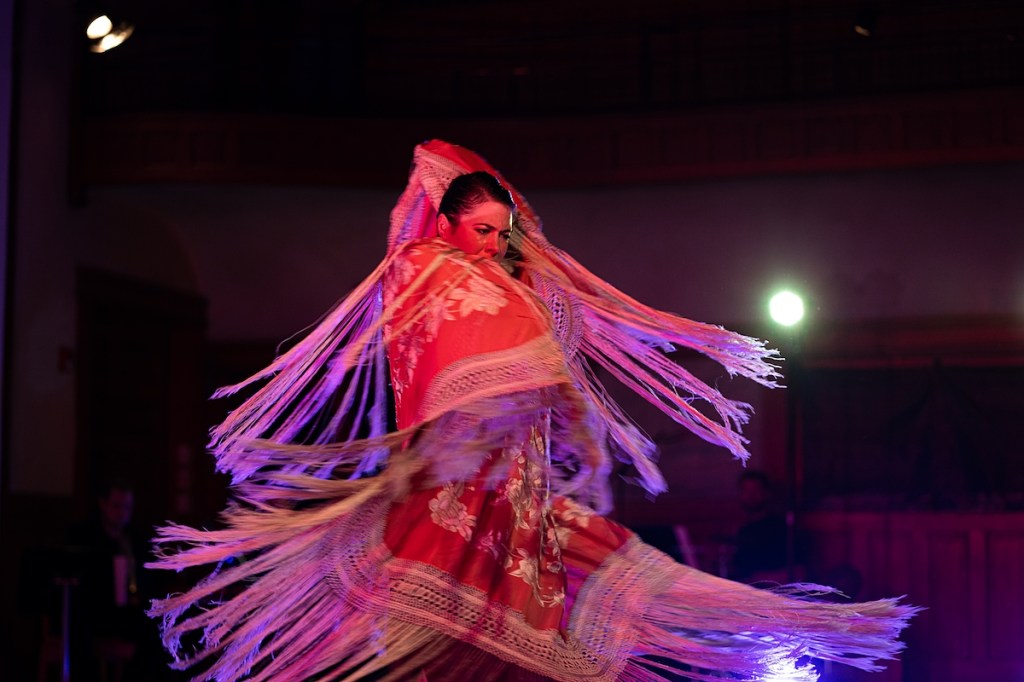
It is summed up in my company’s name, Abrepaso, which comes from the Spanish phrase ‘se abre paso,’ meaning to open space or forge a new pathway. I started Abrepaso to present more avant-garde and contemporary flamenco in the U.S., as opposed to the more stereotypical images (the woman in the red dress) that cater to what audiences expect. At the same time, I wanted the company to be about creating space for people to share their stories and not just imitate Spanish ones.
Does that philosophy extend to your teaching of flamenco?
Absolutely. Feedback from people who see my students dance is that they are unique, and that is so important to me. Yes, there is an aesthetic, technique, and structure to flamenco, but I also support my students in finding their individual expression in the music. I incorporate improvisation and elements from other dance styles, such as contemporary and postmodern dance, so that my students can find ways to move organically.
You remain at the peak of your skills as a dancer and performer, beyond Abrepaso. Do you freelance?
Yes, I travel a little bit, teaching and performing with other flamenco companies, and I also choreograph for universities as a guest choreographer.
You are also a choreographer. What is your choreographic process?
I approach creating a work with a seed of an idea and an open mind. I then build more material through improvisation, which is where discoveries are made. For me, choreographing is an exploration. I gather and arrange ideas and movement from those experimentations and explorations with the dancer to create a work.
What drives you as a flamenco artist?
Live performance is so important. That exchange between audience and performer of energy is so vital. Additionally, I am passionate about educating people about flamenco, as there are many incorrect assumptions about it, which really frustrates me and pushes me forward.
What’s the biggest assumption about flamenco?
That you have to be Spanish to be an authentic flamenco artist. It’s a misconception that there is some authentic version of flamenco that has to do with where a person is from rather than what they do within flamenco.
What are your long-term goals for Abrepaso?
Continuing our mission, creating a new evening-length work every other year, and continuing to build our community and education programs, such as Soleá Project, where flamenco movement, rhythm, and poetry are paired with visual arts and creative movement, to give participants the space to express grief, loneliness, and joy, and to heal through creative arts.
Abrepaso performs Ni más/ni menos, Thursday, November 20, and Friday, November 21, at 7:30 p.m. at the Cultural Arts Center at Disciples Christian Church, 3663 Mayfield Road, Cleveland Heights. General admission tickets are $45 each and can be purchased at abrepaso.org.

 artsair.art